
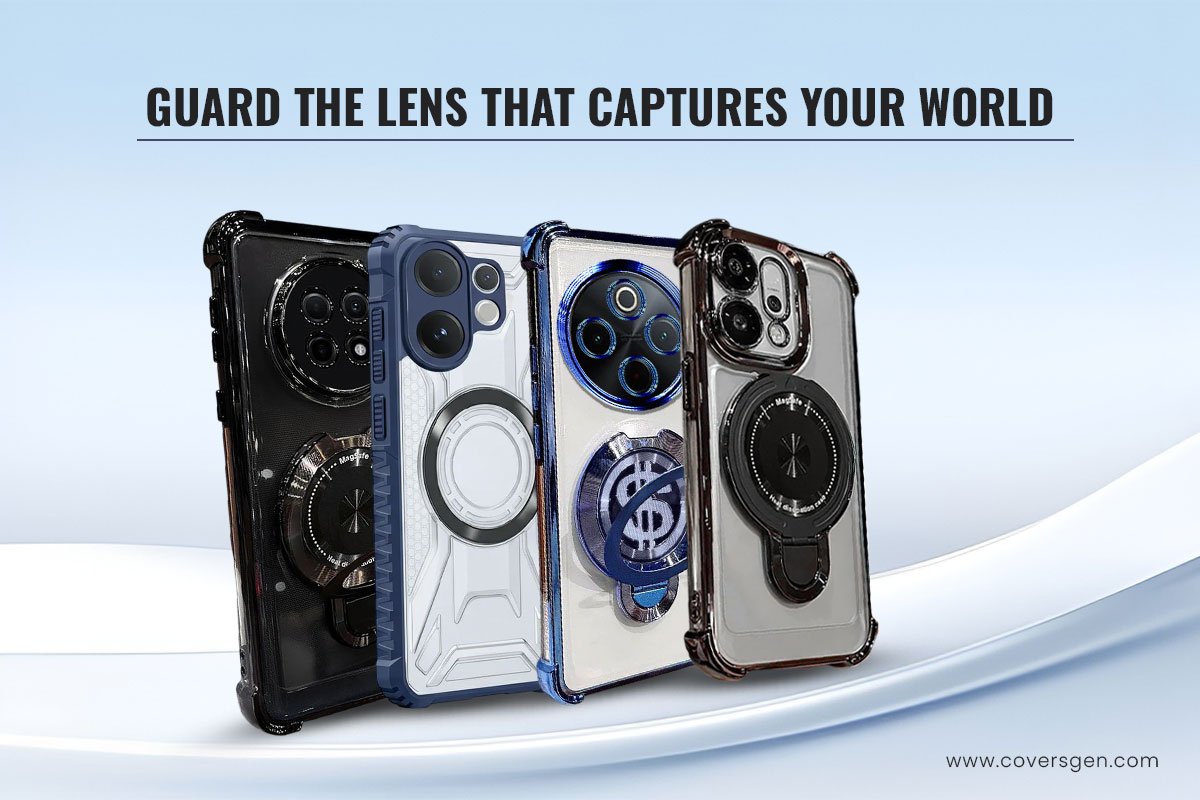
Modern smartphones have developed into advanced imaging devices that can compete with dedicated cameras that were only 10 years ago. However, despite their incredible capabilities, these fragile optical components are still susceptible to harm that even the strongest screen protectors aren’t able to stop. Understanding why your lens protection plan must go beyond glass guards that simply is a matter of examining the intricate structure of modern camera modules as well as the mechanics of impact.
The Complex Architecture of Modern Camera Modules
Smartphone cameras today are marvels of tiny engineering. Each camera is made up of multiple precisely aligned parts working together to create high-quality images. The core of the module is the image sensor, typically one CMOS chip that measures 1/2.55 inches or less. It’s covered with an infrared filter, and then secured by a sapphire or glasses lens component.
The lens assembly itself is made up of a number of glass or plastic components placed in a stack, each polished and ground to micron-sized tolerances. The elements are paired to correct optical distortions while creating a compact design. The whole assembly is mounted on the voice coil motor to provide autofocus capabilities, as well as bigger sensors that incorporate optical image stabilization (OIS) systems that employ ball bearing suspensions or electromagnetic actuators to adjust for hand movements.
The advanced hardware occupy an extremely small space–often smaller than 50 cubic millimeters. It also extends from the rear surface by around 1-3 millimeters for most flagship phones. The protrusion, though vital for optical performance is a major vulnerability that glass protectors aren’t able to solve.
The Fundamental Limitations of Glass Lens Guards
Lens protectors for cameras made of sapphire or glass that has been tempered are becoming popular items and are marketed as essential security for high-end smartphone lenses. While these items do offer some advantages, their security abilities are restricted by the physics of design and restrictions.
Surface Scratch Protection: The Only True Benefit
Glass protectors are excellent at a particular task that is preventing scratches on surfaces caused by keys, sand and other abrasive substances during daily handling. The Mohs hardness scale, which is a measure of scratch resistance–puts glass with tempered properties at 5.5-6 in comparison to sapphire, which is 9th, second just to diamond, which is 10, which is second only to diamond at. In terms of context, the majority of smartphones camera lenses are made of sapphire or hardened glass that has similar ratings.
The addition of a protector that has comparable or better hardness will stop micro-scratches which can decrease the quality of images in time. However, this has a set of trade-offs, which are often not considered by users.
Optical Degradation: An Unavoidable Compromise
Every glass surface that is added to the optical path could result in image quality issues. Light reflecting off the protector’s surfaces can cause flare, reduce contrast, and decrease overall sharpness–particularly noticeable in challenging lighting conditions or when shooting directly toward light sources.
Even top-quality protectors with anti-reflective coatings aren’t able to totally eliminate these effects. Multi-coated cameras undergo advanced coating processes in controlled conditions each layer being specifically designed for specific wavelengths. The aftermarket protectors are unable to replicate this level of precision, and will ultimately compromise the optical quality that manufacturers invested millions of dollars to develop.
Impact Protection: Where Glass Guards Fail Critically
The most serious danger to smartphones’ cameras isn’t scratches on the surface, but impact injury caused by drops. Glass lens protectors aren’t much use and can increase the vulnerability of your camera.
If a phone is damaged it has to be absorbed somewhere. A glass-like protector that is bonded directly to the lens is not able to absorb a significant amount of impact force. Instead, it could shatter on impact, fragments possibly scratching the lens or, in extreme cases, the sharp edge of the damaged protector glass acts as an instrument for cutting to the camera assembly itself.
Furthermore Glass protectors can do little to stop the most frequent and destructive kind of damage to cameras that is the impact on the camera’s internal components. The lens stack is delicate and mount for the image sensor, OIS mechanism and the autofocus motor could all be permanently damaged due to force of shock that is transmitted through the phone’s body even if the lens’s outer element is not damaged.
The Physics of Camera-Safe Phone Protection
Effective lens protection for cameras like these oppo F31 pro plus cases that must address the fundamental principles of the impact event. When a smartphone is dropped on an un-porous surface and collides with it, it creates force waves that spread through the structure of the device. These forces may cause misalignment between optical elements, cause damage to the image sensor, crack solder joints inside the electrical connections of the camera module or permanently damage or deform OIS suspension structure.
Raised Bezel Design: Creating a Protective Air Gap
Premium phone cases that have raised bezels around the camera array function by applying a simple, but powerful principle that stops the camera from making contact directly with surfaces that are impacted. By stretching 0.5-1.5 millimeters over the camera’s protrusion the bezels make an air gaps, which ensures that the lens doesn’t touch the ground in a majority of drops.
The seemingly small elevation offers significant protection benefits. Drop tests conducted by independent labs, phones that have raised bezels exhibit a reduction of 60 to 80% in camera-related damage when compared with unprotected phones even when dropped from heights of more than 1.5 meters on concrete.
The design of the raised bezel spreads impact forces throughout the structure of the case, rather than concentration of them on the mounting points of the camera module. The force redistribution greatly reduces the impact force transmitted to component of the camera’s interior.
Material Science: Shock Absorption Through Strategic Compliance
The materials used in camera safe phone covers play a important role in protecting. Thermoplastic Polyurethane (TPU) and specially-formulated silicone blends provide better shock absorption over rigid materials such as polycarbonate or aluminum.
These elastomeric substances work by the process of hysteresis. It converts energy into heat by internal friction when the material deforms and then recovers. A high-quality TPU is able to absorb 60-70 percent of energy from impact significantly reducing the force that is transmitted to the phone’s camera system.
Advanced cases make use of multi-material construction, which combines hard polycarbonate shells for the outer layer and TPU inner lines. This approach is a hybrid that provides structural rigidity to keep the air gap for protection and a supple shock absorption system to absorb impact forces. Certain premium designs include honeycomb or air pockets which expand during collision, further increasing energy absorption.
Corner and Edge Protection: Addressing Real-World Drop Dynamics
A statistical analysis of smartphone falls shows that about 70% of them land on edges or corners instead of falling flat. This is why corner reinforcement is crucial to ensure complete camera protection. The force generated by rotation during corner collisions can be especially detrimental to camera modules because of the force applied to the structure of the mounting.
Cases with reinforced corners that have the most robust shock-absorbing material in these critical areas dramatically reduce the force of rotation. Drop protection that is standard for military (MIL-STD-810G) cases generally have large corner bumpers, which extend several millimeters beyond the phone’s contour, forming what engineers refer to as “sacrificial crush zones.”
Beyond Physical Protection: Long-Term Performance Preservation
Effective lens protection for camera lenses goes beyond preventing damage that could be catastrophic to maintain the long-term performance of optical technology. Moisture, dust, and thermal stress affect camera performance in time.
High-quality cases that have sharp camera cutouts and a an overhang that is slightly overhanging creates an airtight seal that minimizes dust buildup on the lens’s surface. Although not completely sealed, this design greatly reduces dust infiltration that could work its way through spaces between lenses over the course of months of usage.
Certain cases are specially designed to incorporate hydrophobic coatings for the bezel around the camera cutout. This causes water to bead and then roll away from the path of view. This is particularly beneficial for photographers who shoot in humid conditions or in light rain.
Conclusion: Comprehensive Protection Requires Holistic Design
The science behind camera protection for smartphones has revealed the obvious conclusion that lenses guards made of glass address the most basic threats while possibly compromising the quality of optical image and unable to protect against the possibility of damage internally-connected components. The true camera lens protection needs an entire approach, centered around anti-scratch protection with carefully designed raised bezels as well as shock-absorbing materials.
For those who have made a significant investment of $800-$1500 in flagship smartphones with sophisticated camera systems to protect their investment, it is necessary to invest more than a glass sticker of $10. High-quality camera-safe phone covers even though they are more expensive at between $30 and $60, offer more protection by taking on the entire spectrum of security threats with careful engineering built on impact physics, materials science and optical design principles.
The decision isn’t about security and convenience, but between simple solutions and the comprehensive protection of the advanced imaging technology that makes smartphones the most sought-after cameras.