
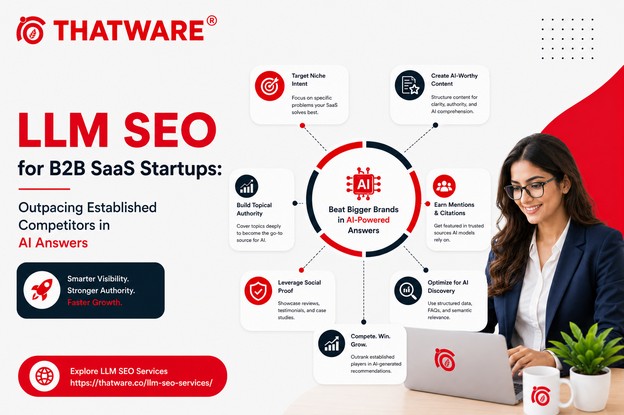
There’s a counter-intuitive opportunity hiding inside the LLM SEO landscape for B2B SaaS startups — one that the incumbents they’re competing against haven’t fully recognized yet.
Large, established SaaS companies have legacy advantages: massive link profiles, years of content, recognizable brand names, analyst relationships. In traditional SEO, those advantages are nearly impossible to overcome for a two-year-old startup. The incumbents own the first page of results for every high-value keyword. The game is rigged.
LLM SEO is a different game. Not completely different — authority and credibility still matter. But the specific kinds of authority that drive AI citations are more accessible to well-positioned startups than keyword ranking dominance ever was. And the incumbents, ironically, often have worse LLM visibility than their traditional SEO dominance would suggest.
Here’s why, and what startups can do about it.
Why Incumbents Underperform in AI Visibility
This is worth understanding deeply because it’s the root of the opportunity.
Established SaaS companies often have years of content that contradicts itself. Messaging pivots, repositioning efforts, acquired brands with conflicting descriptions, product names that have changed — all of this creates a messy, inconsistent entity representation that AI models struggle to synthesize cleanly. A company that’s been around for fifteen years and sold into enterprise may have content on its site that ranges from small business-focused early blog posts to current enterprise messaging, making it hard for models to confidently categorize them.
Large companies also tend to produce content that’s broad and hedging — designed to appeal to the widest possible audience, not to speak specifically to any particular buyer’s context. “We help businesses of all sizes achieve digital transformation” is useless to an AI model trying to determine whether to recommend this vendor to a specific questioner.
Additionally, many incumbents have spent heavily on traditional SEO optimization that doesn’t translate to LLM visibility — keyword-dense content that’s thin on actual information value, backlink profiles built on manipulative practices that don’t create genuine authority signal, and site architecture optimized for crawling rather than comprehension.
A focused, well-positioned startup can build a cleaner, more specific, more current entity representation than many incumbents — and leapfrog them in AI-generated answers for specific use cases.
The Positioning Precision Advantage
For B2B SaaS startups in crowded categories, specificity is the primary competitive weapon for LLM visibility. Rather than competing to be the best general solution (“the best CRM”), build AI visibility as the best solution for a specific, well-defined use case (“the best CRM for independent financial advisors managing recurring revenue clients”).
AI models are better at matching specific entities to specific queries than they are at ranking generalist solutions. A startup that owns a specific niche in the AI knowledge ecosystem — through deeply focused content, community presence in that niche, and third-party coverage that consistently frames them in that context — can dominate AI-generated answers for their specific market segment even against competitors with far more overall authority.
This is the LLM SEO analog of “niche first” product strategy. Own the specific before expanding to the general. The brand that wins “best CRM for financial advisors” in AI answers has a meaningful commercial advantage in that segment, even if it’s nowhere in “best CRM” overall.
LLM SEO services for B2B SaaS that understand startup dynamics will help identify the specific category niche where AI authority is most achievable and most commercially valuable, rather than trying to compete across the board.
Moving Faster Than Incumbents Can React
Startups have a structural advantage that’s easy to underestimate: speed. In LLM SEO, the ability to move quickly — to produce focused content, build targeted coverage, establish specific entity signals — matters because the AI visibility landscape is being actively built right now. Early movers in specific niches are establishing representations that will be harder to displace once they’re established.
Incumbents, burdened by content governance committees, brand guidelines, agency relationships with long lead times, and internal approval processes, simply can’t move as fast. A B2B SaaS startup with a focused team and a clear niche positioning can build meaningful AI visibility in six months that would take an enterprise competitor two years to replicate.
This window won’t be open forever. As awareness of LLM SEO spreads and larger companies invest systematically, the early-mover advantage will compress. The startups building now are getting years of compounding on their AI authority before the incumbents wake up to the opportunity they’re ceding.
Content Strategy for the Startup Constraint
B2B SaaS startups typically have limited content resources — maybe one or two marketers, no in-house SEO team, a founder who could write but has twenty other priorities. LLM SEO content strategy needs to work within those constraints.
The highest-leverage content investments for startup LLM visibility: technical thought leadership from the founders (genuine, specific perspectives on the problem your product solves — not marketing, actual intellectual contributions), detailed use-case documentation on your own site (specific enough to answer specific customer questions), and one or two pieces of original research or data per quarter that create citable factual anchors.
This is a manageable volume. Ten excellent pieces of deeply specific content outperform a hundred generic blog posts for LLM visibility. Startups shouldn’t try to compete on content volume — they should compete on content quality and specificity.
Partner and Integration Ecosystem as an AI Signal
One specific LLM SEO tactic that’s highly accessible to B2B SaaS startups: integration ecosystem documentation.
If your product integrates with Salesforce, Slack, HubSpot, Zapier, or any other platform with a significant ecosystem, ensuring those integrations are documented — on your site, on the partner platform’s marketplace listing, in integration directories, and in community discussions about those platforms — creates cross-referencing entity signals that AI models pick up on.
“What tools integrate with Salesforce for [specific use case]?” is a query category where startup SaaS companies can earn AI citations by being well-documented in integration ecosystems. This is territory that many startups have already invested in for traditional SEO and product-led growth purposes — the same documentation that drives App Store optimization and marketplace visibility also contributes to LLM visibility.
Hire LLM SEO agency services for early-stage B2B SaaS should identify these existing assets — integration docs, customer case studies, community presence — and build a strategy that leverages them for AI visibility rather than starting from scratch. In early-stage startups especially, connecting existing investments to LLM SEO goals maximizes efficiency.
The opportunity for B2B SaaS startups in AI-generated answers is real and time-bounded. The incumbents will catch up eventually. But right now, a focused startup with precise positioning and a smart content strategy can build AI authority in their niche faster than any established player can respond. That window is worth sprinting through.